
Northwest Coast Artist Manda Hugon on Finding Home Through Art

When you speak with Northwest Coast artist Manda Hugon, you immediately feel the honesty and heart she brings into everything she creates. Born in Chilliwack and raised in Terrace on the unceded territory of the Tsimshian people, Manda carries connections to the Kwikwetlem and Cheam Bands of the Stó:lō Nation, as well as her Michif heritage. She didn’t grow up immersed in her Indigenous community. Later, she came to understand and embrace her identity through art, land, and stories.
After trying life in the city, Manda returned to Terrace, drawn back by the mountains, the crisp air, and a sense of belonging she couldn’t ignore. There, she enrolled in the Freda Diesing School of Northwest Coast Art. The decision changed everything.
In learning traditional formline, carving, painting, and harvesting materials like cedar, she also learned about herself. “Art helped me find who I am,” she says. “It helped me find family that I never got to meet.”
Manda’s journey as an artist is deeply tied to natural materials: cedar, alder, birch, and hide. Each carries its own life and spirit. She describes her process as a conversation between herself and the material, one that shifts, changes, and reveals. Her work is rooted in intention: grounding, smudging, and bringing positive energy into every piece. “Everything I make has a part of me in it,” she explains. “The stories are personal and sharing them feels like sharing a little piece of myself.”
Today, Manda is both a Northwest Coast artist and a professional muralist with the Raven Tacuara Collective, painting large-scale public works across B.C. Her designs draw from the land, the salmon, the birds, the mountains—the interconnectedness of all living things. Much of her artwork reflects the full cycle of life and how nature sustains us spiritually, culturally, and physically.
Working on the George Ingham Plaza Design
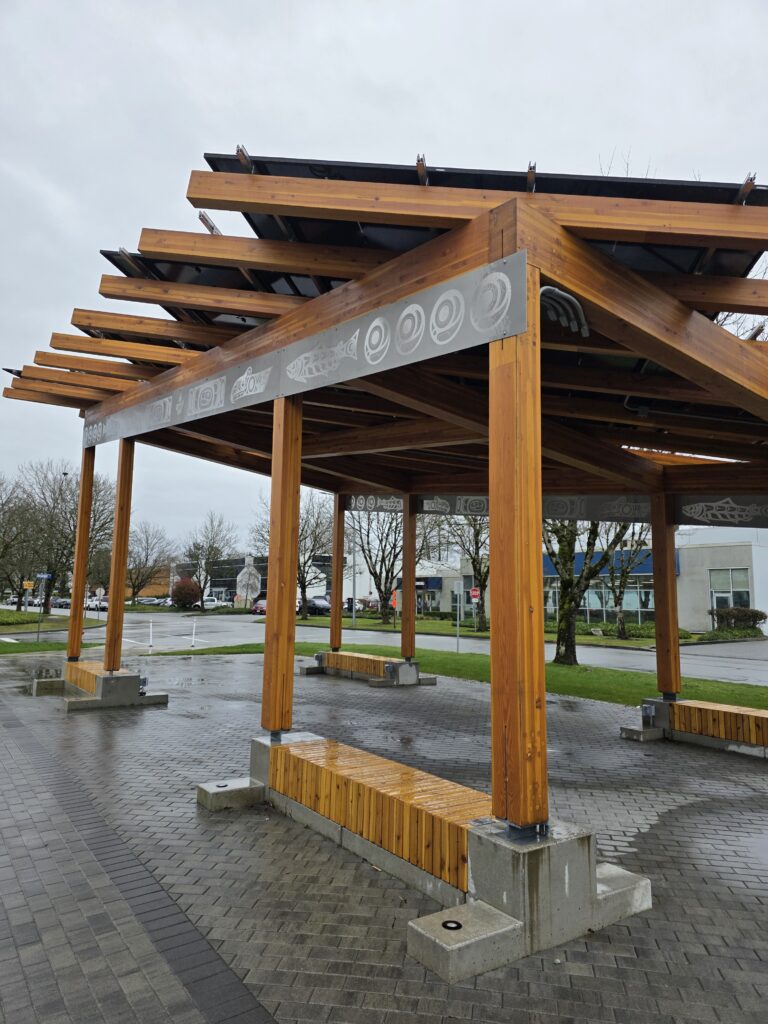
Creating a design for the George Ingham Plaza was a meaningful project for Manda. Her goal was to bring teachings, stories, and relationships into a public space. A place where community members can connect with the land and with one another. As with all her work, the design came from a place of intention, honouring the land, the animals, and the stories that shape who we are.
The Story Behind the Design
At the heart of Manda’s design is her own interpretation of the Canadian flag, indigenized through the Northwest Coast to honour the land beneath our feet. For her, this version of the flag represents not only where we live, but the deep connection people across B.C. and Canada share with this land.
On the outskirts of the flag is a Thunderbird, a powerful mythical being. Manda explains, “In my grandma’s story, the Thunderbird brings the salmon back to the people, restoring balance and sustaining communities.” A salmon and four salmon eggs appear in the design, the same ones featured in her work at Lafarge Lake, symbolizing the salmon’s full lifecycle and humanity’s relationship with it.
For Manda, these designs showcase the interwoven relationships among land, animals, and people.
More Than A Beautiful Design
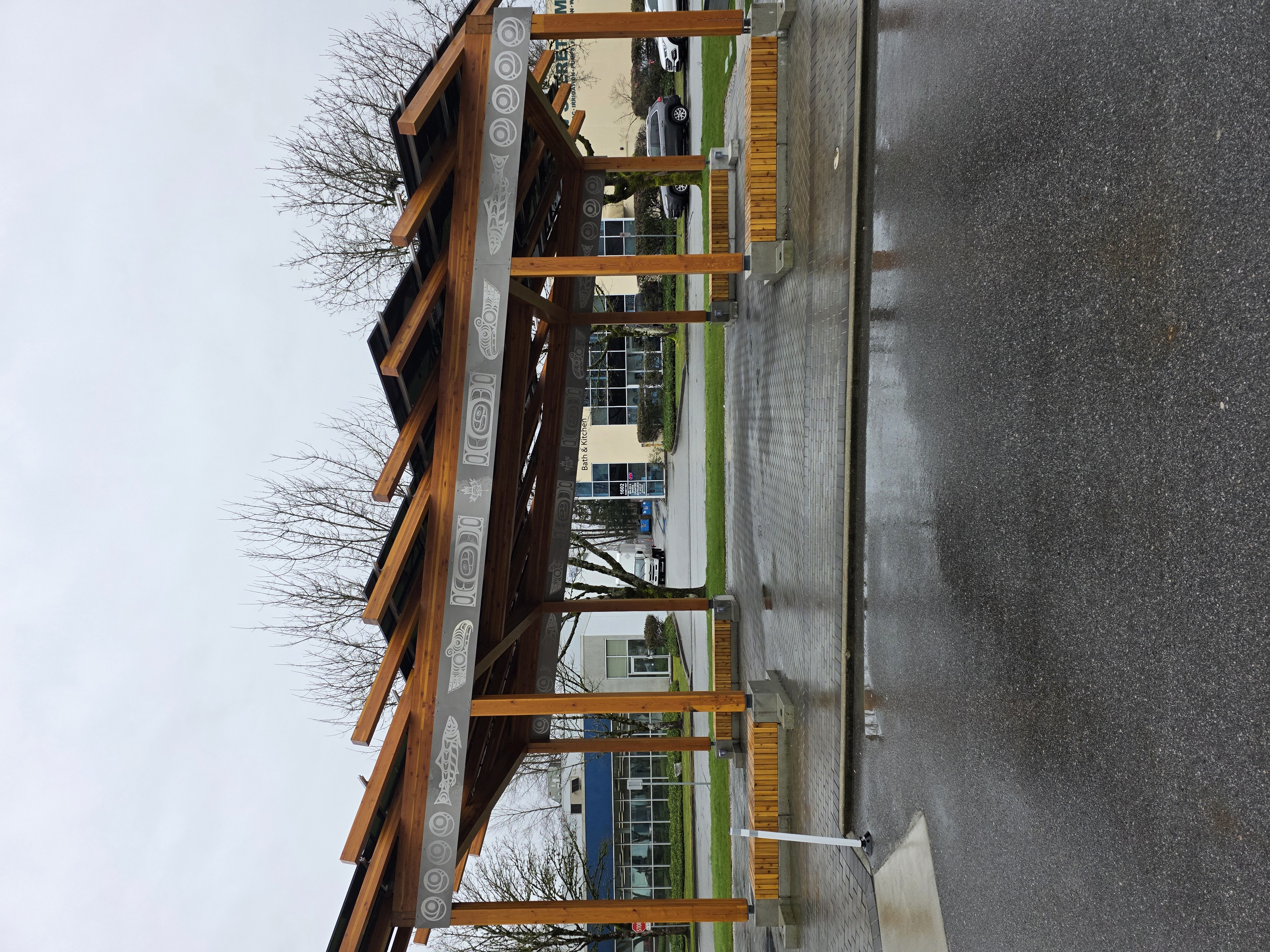
Placing Manda’s artwork in George Ingham Plaza is more than showcasing a beautiful design. It welcomes her story, her ancestors, her teachings, and her connection to the land into a shared space. It invites viewers to slow down, look closely, and feel the life within the work. Because for Manda, art is not just something you see; it is something you feel.
And she hopes you feel that connection too.
Written by: Savannah Davis, ClearWater Communications Co.